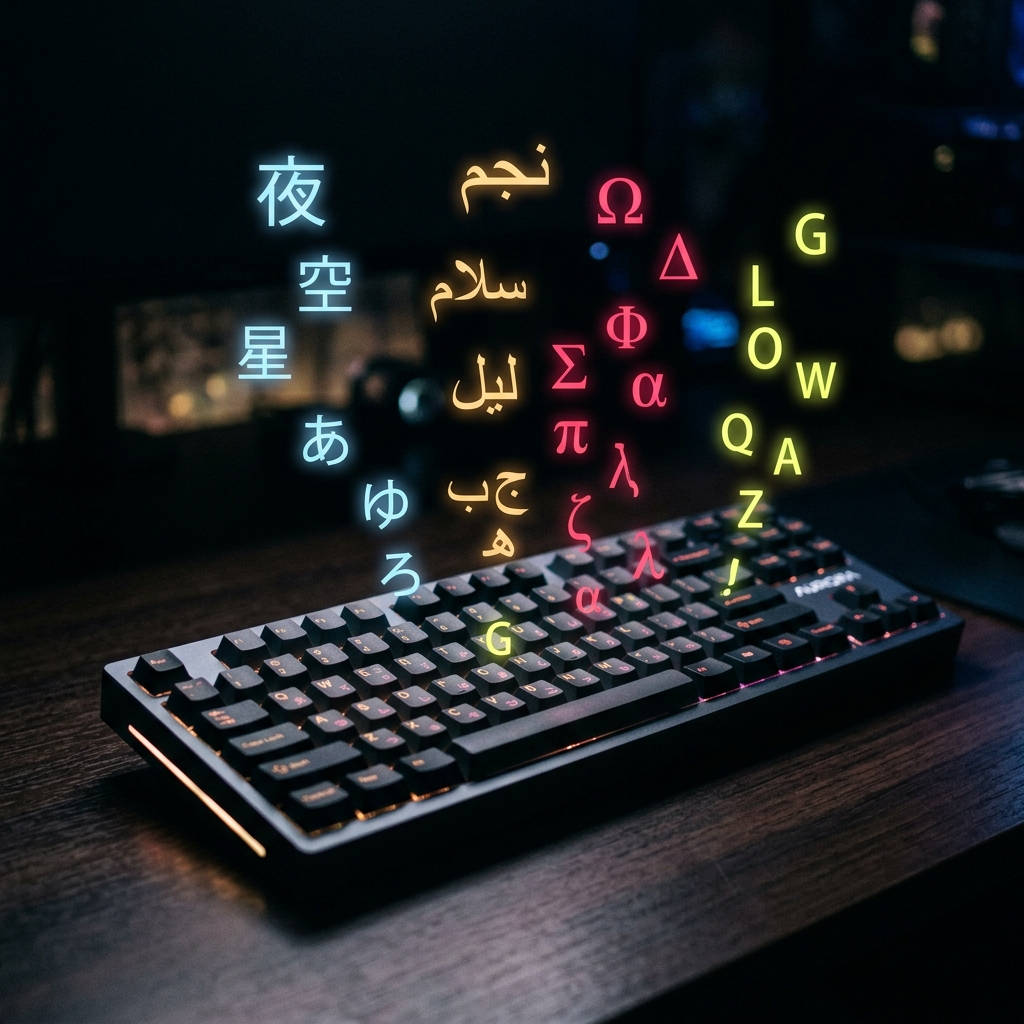
In our globalized world, many of us need to communicate in multiple languages. But switching from English to Japanese, or Spanish to Arabic, involves more than just a different vocabulary—it involves a fundamental shift in how you interact with your keyboard. Multi-lingual typing is a unique cognitive challenge that requires specialized training and mental flexibility.
The Cognitive Load of Layout Switching
When you switch layouts (e.g., from QWERTY to AZERTY), your brain has to "unlearn" years of muscle memory temporarily. This can be incredibly frustrating. The key is to treat each layout as a separate "mode" of operation. With enough practice, your brain can learn to switch these modes instantly, similar to how a polyglot switches between languages in conversation.
Visual Cues and Keycaps
If you type in two languages frequently, consider "Dual Legend" keycaps that show both sets of characters. While the goal is always touch-typing, these visual cues can help during the transition phase. However, for true mastery, you should aim to memorize both layouts so you can switch even on a blank keyboard.
Mastering Accents and Diacritics
Many languages require accents (á, ö, ñ). Learning the "Dead Key" method or specialized ALT-codes is essential. On modern operating systems, long-pressing a key or using a "Compose Key" can simplify this process. Find the method that feels most natural to you and practice it until the accents become a seamless part of your typing rhythm.
IME (Input Method Editors): Typing Non-Latin Scripts
Languages like Chinese, Japanese, and Korean use IMEs to convert phonetic input into characters. Mastery here involves not just fast typing, but fast "selection." Learning to use the Spacebar or Number keys to quickly pick the correct Kanji or Hanja is a secondary skill that is just as important as the typing itself.
The "Language Toggle" Habit
Customize your OS shortcuts for switching languages (e.g., Win+Space or Cmd+Space). Make this movement as automatic as a capital letter. The faster you can switch, the less your creative flow is interrupted. A multi-lingual master doesn't stop to think about the layout; they just start typing in the new language.
Conclusion: Expanding Your Digital Reach
Typing in multiple languages is more than a technical skill; it's a way to connect with different cultures and ideas more deeply. Don't let the fear of a new layout hold you back. Use Funnytyping's multi-language support to practice your target languages and become a truly global digital citizen.